

Many manufacturers still rely on Excel or CSV files for reporting. These tools work for simple tasks, but they create problems once operations expand. Large files slow down. Users overwrite formulas. Teams work with different versions of the same document. Excel can technically connect to other systems, but the process is cumbersome and difficult to maintain at scale. As a result, it struggles to support the level of automation and integration that modern production environments require..
Modern data analytics in manufacturing industry environments require more than spreadsheets. Manufacturers need automated and integrated analytics systems that keep data clean, consistent, and ready for deeper insights. Unstoppable Software helps teams modernize their data process without replacing the tools they already use.

Step 1 – Automate Data Validation
Manually entered data is one of the biggest sources of errors. A mistyped number or a misplaced decimal can spread across multiple reports before anyone notices. These errors delay key decisions and reduce confidence in the data.
Automated validation solves this problem. Instead of cleaning data after it has already reached a report, the system checks it at the source. Missing fields, corrupted values, and inconsistent formats are flagged instantly.
Unstoppable Software builds automated validation directly into the data pipeline. This ensures that every file passing through the system is clean and accurate. Teams save time, avoid manual rework, and gain reports they can trust.
Step 2 – Integrate Systems for AI-Ready Data
Excel can store information, but it cannot explain how different parts of the business relate to each other. Most spreadsheets only focus on a single function because Excel does not scale well when teams try to cross reference data from multiple files. As datasets grow, linking information across separate sheets becomes slow, error prone, and difficult to maintain.
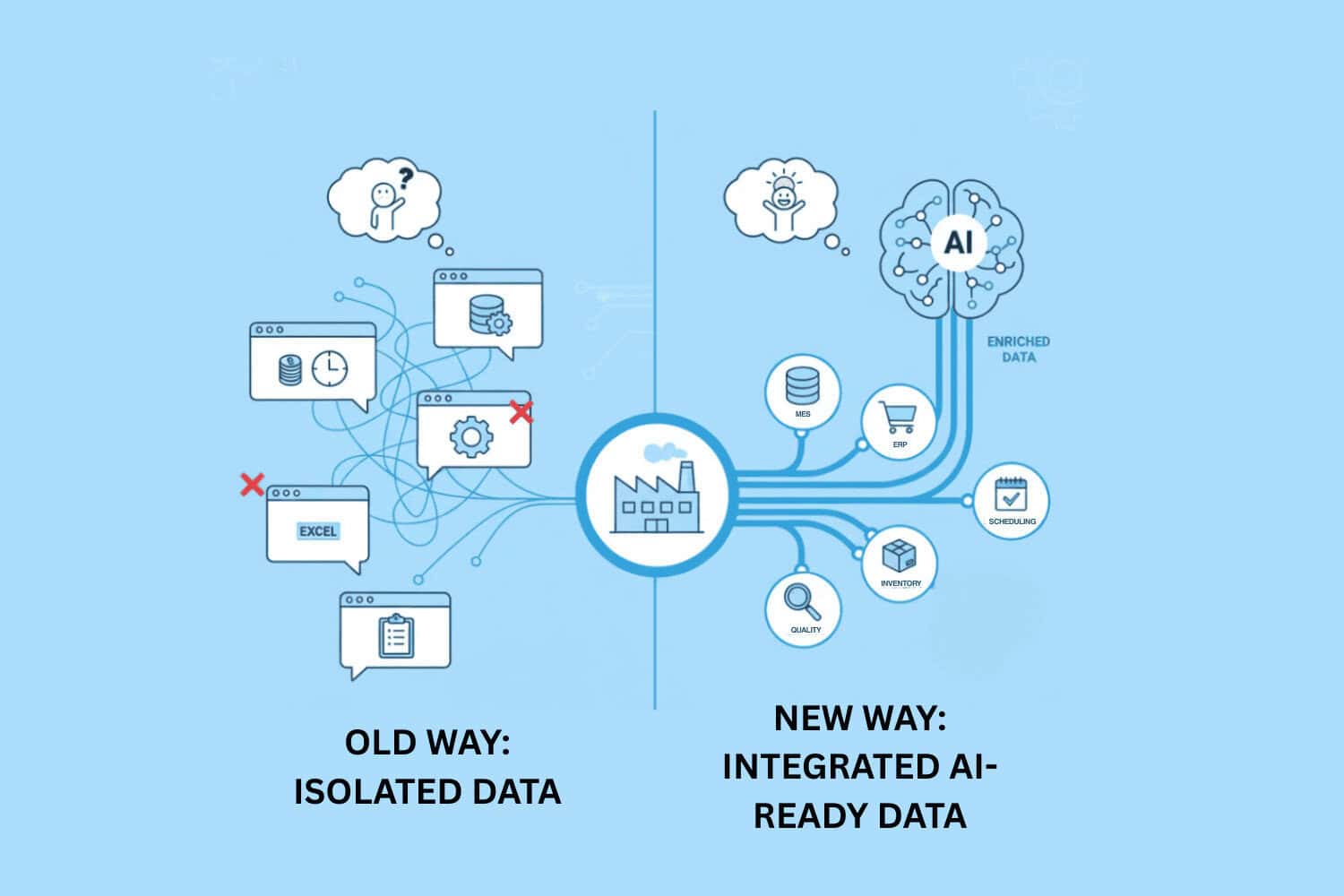
This is where integration becomes essential. When systems such as MES, ERP, quality control, inventory, and production scheduling communicate with each other, the data becomes enriched. Instead of looking at isolated numbers, manufacturers can understand how each process affects the next. This enriched data tells a more complete story of what is happening on the production floor.
For example, production output data becomes more meaningful when it is connected to machine usage, labor allocation, maintenance history, and material availability. These relationships cannot be captured reliably in Excel, especially when multiple users and large datasets are involved.
Unstoppable builds integrations that connect these systems into a unified data flow. Our team creates structured pipelines that combine information from every part of the operation, producing datasets that are clean, consistent, and ready for advanced analytics or AI models. This gives manufacturers the context they need to make faster and more accurate decisions. It also removes the manual work of pulling reports from separate tools and stitching them together in spreadsheets.
By enriching the data through integration, manufacturers gain clarity, depth, and visibility that Excel alone cannot provide. This lays the groundwork for predictive insights and stronger decision making across the entire organization. ‘
Step 3 – Balance Data Size and Accuracy
Excel becomes harder to manage as data grows. Large files slow down, especially when calculations, pivot tables, or multiple tabs depend on each other. Teams often create different versions of the same report, which leads to inconsistent numbers and broken formulas. Since Excel has no built in version control, there is also no reliable way to track changes or maintain a single source of truth.
Excel also has limited ability to relate data from multiple files. While it can link workbooks, these connections break easily and do not scale for manufacturers who rely on MES, ERP, quality systems, and production logs. As datasets grow larger, these links become unstable and difficult to maintain, which restricts how teams combine and analyze information.
These limitations slow down analysis, reduce accuracy, and make it difficult to build consistent workflows across departments.
Unstoppable Software helps manufacturers move beyond Excel by creating systems that are fast, scalable, and secure. Data flows automatically from each source, updates in real time, and is stored in structures designed for analytics. This eliminates version conflicts, broken formulas, and manual consolidation, giving teams a stable foundation for reliable decision making.
Bringing It All Together
Reliable data is the foundation for smarter decision making. By automating validation, strengthening manufacturing data integration, and replacing Excel based workflows with scalable analytics tools, manufacturers gain the clarity they need to improve operations.
Unstoppable Software strengthens these systems without interrupting production. Their team designs tools that layer onto existing workflows so manufacturers can modernize without a full rebuild.
Start Building Smarter Data Systems with Unstoppable Software
If your team is ready to move beyond spreadsheets and build a dependable analytics process, Unstoppable Software can help. Our custom solutions support manufacturing data automation, they clean and connect your information, and elevate your data so your team can focus on insight and performance.
FAQs
1. Why should manufacturers move beyond Excel with Unstoppable Software? Excel is useful for basic tasks but unreliable for scaling operations. Unstoppable Software builds systems that handle larger datasets, maintain consistency, and support real time analytics.
2. What does automated data validation mean, and how does Unstoppable help? Automated validation checks data for errors before it reaches the next step in the process. Unstoppable Software adds these checks into the data pipeline so teams do not need to clean files manually.
3. How can Unstoppable Software improve data integration for analytics? Unstoppable connects MES, ERP, and production systems to create a single data flow. This enriched data offers a more complete picture of manufacturing performance.
4. Do I need to replace my current systems to work with Unstoppable Software?
No. Unstoppable improves your current systems by adding automation, integration, and scalable analytics where it is needed.
5. What is the ROI of automating data analytics with Unstoppable Software?
Teams save time, reduce errors, gain better visibility, and make faster decisions. This leads to better operational performance and measurable long term value.


