

About This Report
Throughout 2025, we interviewed manufacturing professionals across environmental equipment, HVAC distribution, building materials, flexible packaging, and others. These conversations revealed a stark gap between digital transformation rhetoric and reality.
If you’re an operations leader at a mid-sized manufacturer, this report shows where your peers are struggling, what’s actually working, and how to avoid the most common pitfalls.
The Three Universal Challenges
Challenge #1: The Data Paradox
Every manufacturing leader faces this: you’re generating massive data, but can’t get actionable insights when needed.
A CPA consultant working with manufacturers explained: “The system doesn’t let you get the data out the way you want it.” Data is trapped in systems requiring IT expertise to extract anything useful.
An environmental equipment manufacturer described having decades of historical projects, but extracting information is so cumbersome that engineers start from scratch. “We just use old drawings a lot of times” even though the data exists in their systems.
Even a Fortune 500 building materials company admitted: “We can’t get the data out the way we want it. It’s very frustrating.” Despite sophisticated ERP systems across multiple countries, cross-plant comparisons remain painfully difficult.
The Real Impact: When official systems can’t deliver timely insights, workers create shadow systems (e.g. Excel spreadsheets, Access databases, and manual reports) that undermine digital investments. One company attempted to eliminate spreadsheets four years ago. Today they’ve only reduced usage by 50%.
Manufacturing professionals emphasized that organizations accumulate terabytes of unstructured data with no governance strategy. Industry research shows 90% of manufacturers claim AI use, but if you can’t export clean data from your ERP, those AI initiatives are likely superficial pilots.
What You Need: Before investing in analytics, ensure your team can answer these questions in under 10 minutes:
- Can a plant manager pull last month’s scrap data?
- Can your quality team compare defect rates across products without IT support?
- Can your maintenance supervisor see which machines are approaching service requirements?
If the answer is “no,” you have a data accessibility problem that will make advanced initiatives very difficult.
Challenge #2: Integration Hell
Every operations leader described incompatible systems requiring manual transfers, duplicate entry, and visibility blind spots.
A distribution company with 30+ sites discovered that after acquisition: “The company that purchased us was also on [the same ERP Platform], but they have made 200+ modifications over the years… we use basically the package as it sent out.” Now they operate parallel ERPs with different product files, which has become “somewhat of a nightmare.”
This is increasingly common as consolidation accelerates. Wells Fargo notes manufacturing remains cyclical, meaning more acquisitions during downturns, compounding integration debt.
A consultant explained why this persists: “Most organizations don’t take advantage of everything [their ERP] offers because they see the cost, they get sticker shock at the front end.” Companies pay for 100% of functionality but use 30%, while paying for customizations that duplicate unused features.
Emerging Solution: The consultant revealed clients are creating dedicated roles to “bridge IT and OT,” positions that didn’t exist five years ago. Someone must translate between PLCs, SCADA, and sensors with ERPs, databases, and cloud platforms.
Multiple chemical manufacturers are developing a custom MES specifically because off-the-shelf systems couldn’t integrate. In FDA-regulated manufacturing, integration gaps create compliance risks.
Action Steps: Map your integration landscape:
- What data moves manually between systems?
- What daily/weekly exports does your team perform?
- Where do spreadsheets serve as the “integration layer”?
Each manual touchpoint is both risk and opportunity for immediate improvement.
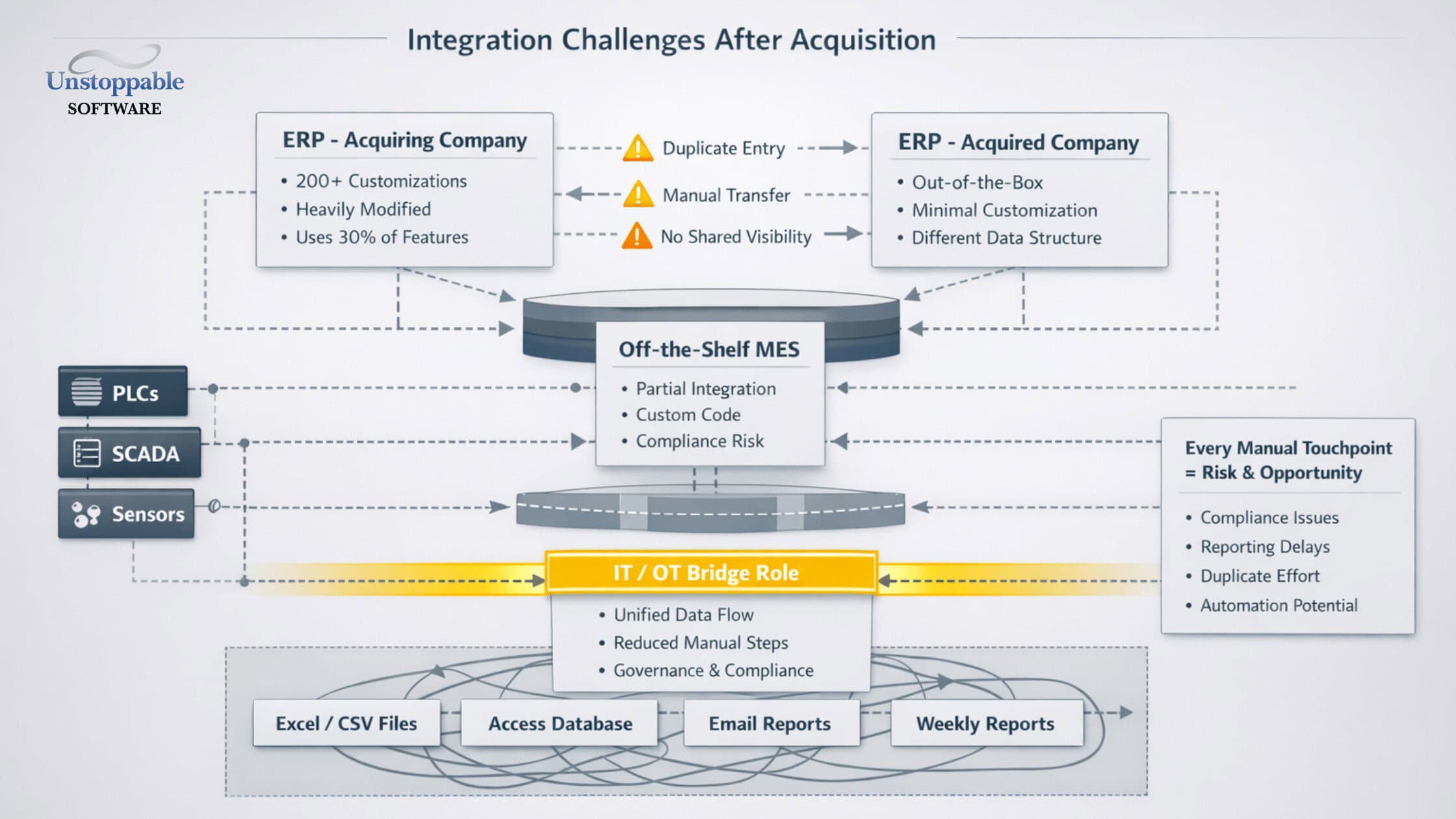
After acquisitions, manufacturers often operate parallel ERPs, layered with off-the-shelf MES and manual workarounds. Each spreadsheet, export, and email report becomes both an operational risk and an opportunity for automation.
Challenge #3: AI Adoption Gap
Industry reports claim 90% of manufacturers use AI. Our interviews show that number reflects pilots and experiments, not production systems delivering value.
The Trust Problem: Manufacturing professionals articulated the fundamental barrier. One explained they need to reproduce errors themselves and verify with their team before believing AI recommendations. Manufacturing’s century-old quality culture is built on reproducibility and root cause analysis. When AI can’t explain its reasoning, it conflicts with this culture.
Manufacturing leaders emphasized they need predictability and control. AI’s probabilistic nature feels like introducing chaos into carefully controlled systems.
A technology veteran was blunt: “AI is a hot term.” They’ve been using AI for years but it may have been called something else at that time. Many vendors rebrand existing analytics as “AI” without new functionality.
Where AI Actually Works:
Three narrow applications emerged:
Digital twins: One packaging manufacturer explained: “We can make those changes in the digital twin and see theoretically, with a high degree of probability, if those results are favorable. That’s a change that we would institute in a live environment.”
Computer vision: Multiple sources described 90% defect detection accuracy. One manufacturer “reduced quality issues by over half within the first quarter” with vision systems for package marking.
Predictive maintenance: A building materials company focuses on using “AI to free up organizational capacity” through automating repetitive analysis, particularly equipment maintenance.
Notice these are targeted applications, not enterprise-wide “AI strategies.”
The Reality: A CPA consultant observed: “Currently, 57% of manufacturing companies are piloting or experimenting with AI technologies, but only 29% have formalized their AI initiatives into corporate strategies.”
AI discussions often originate from executives asking “how can we use AI?” rather than shop floor problems demanding solutions. This top-down approach typically fails.
One consultant distinguished: “I don’t know that the gen AI is going to go as far” in manufacturing because “we have rules” and “we know how things interact.” Generative AI’s probabilistic nature may be mismatched to manufacturing’s deterministic requirements, while computer vision and predictive analytics have clearer value.
Critical Questions Before AI Investment:
- Can we clearly articulate the problem?
- Do we have clean, accessible data?
- Can we explain AI’s decision-making to auditors?
- Will this deliver ROI within 12-18 months?
If you can’t answer “yes” to all four, focus on foundational data and integration challenges first.

AI adoption figures often include pilots, experiments, and rebranded analytics. Interviews reveal that fewer than one-third of manufacturers have deployed AI into production systems with clear ownership, explainability, and measurable ROI.
Additional Trends Worth Watching
Labor Crisis as Digital Driver: A building materials leader noted “people don’t want to go schlep asphalt all day” when cleaner jobs pay more. Automation is about making jobs attractive enough to recruit workers, not just reducing headcount. Workers 35 and under expect real-time data and won’t tolerate manual processes.
Pain-Driven Investment: Manufacturers wait until “it has to be incredibly painful” as one consultant observed. With 12-18 month payback expectations and tightening credit, only crisis-driven projects get approved. Tariff uncertainty worsens this: “no one’s buying anything because it’s so uncertain” about future trade policy.
Legacy Systems Everywhere: Even Fortune 500 companies admit being “very antiquated” with heavily manual processes. Excel remains the de facto operating system, with one company maintaining 50% of spreadsheets four years after implementing replacement systems.
Supply Chain Complexity: HVAC distributors managing seasonal demand and roofing manufacturers as “storm chasers” face forecasting challenges standard ERPs struggle with. Tariff uncertainty creates artificial demand spikes as companies stockpile inventory.
IT/OT Convergence: New hybrid roles bridge information technology and operational technology. IT security policies (mandatory updates, locked access) conflict with OT requirements (24/7 availability, vendor remote access).
Final Thoughts
The interviews reveal an industry far more analog than reports suggest. The gap between “90% using AI” and Excel-based workflows represents both the biggest challenge and opportunity.
Three Takeaways:
You’re not behind: Most manufacturers struggle with the same foundational challenges. Focus on data access and integration before AI.
Start small, prove value: Pain-driven investment means you need quick wins. Pick one high-impact project and execute flawlessly.
People before technology: Labor crisis forces automation, but technology without workforce development creates expensive shelfware. Invest in training alongside systems.
Manufacturers who succeed in the next five years won’t have the most sophisticated AI. They’ll solve the foundational problems of data access, system integration, and workforce adaptation.
The question isn’t whether manufacturing will digitize. It’s whether your organization will digitize fast enough. Your peers are struggling. Winners will start now with focused improvements rather than waiting for perfect solutions.
The good news is, you likely already have most needed data. You have systems that could work better together. You have employees who want to be productive. The path forward isn’t about massive technology investments. It’s about making what you have work as it should.
That’s a solvable problem. The time to start is now.


