

A few weeks after closing an acquisition, a manufacturing company began experiencing unexpected problems.
Inventory reports no longer matched production schedules. Customer records appeared inconsistent. Teams had fallen back on spreadsheets because information from two ERP systems wasn’t aligned. Nothing had technically failed, but decision-making had slowed and visibility across the business had disappeared.
The issue wasn’t the acquisition itself.
It was the data.
This scenario is more common than many manufacturers realize. During M&A, companies often focus on financial and operational synergies but underestimate the complexity of merging business systems and information.
That’s why a strong data migration strategy is one of the foundations of successful IT system integration.
Why Data Migration Fails During M&A
Manufacturing environments are messy.
Companies often rely on:
- Legacy ERP systems
- Excel-based workflows
- Disconnected production systems
- Custom databases
- Manual reporting
When organizations merge, complexity increases.
Without a structured migration plan, companies often experience:
- Duplicated records
- Inconsistent data
- Reporting issues
- Operational bottlenecks
- Production delays
Poor data quality quickly becomes an operational problem.
What a Data Migration Strategy Should Include
Migration should begin long before systems are connected.
A strong approach includes:
- Assessing current systems
- Identifying critical data
- Establishing migration priorities
- Defining validation procedures
- Creating backup plans
- Incorporating cybersecurity controls
Successful migrations support broader IT system integration efforts and help organizations maintain operational continuity.
Inventory and Prioritize Critical Systems
Before migrating information, visibility is essential.
Manufacturers often operate with:
- ERP systems
- MES platforms
- CRM applications
- Quality systems
- Inventory databases
- Spreadsheets
- Custom software
Not every application should be migrated immediately.
Prioritizing critical systems helps minimize risk and prevents unnecessary disruptions
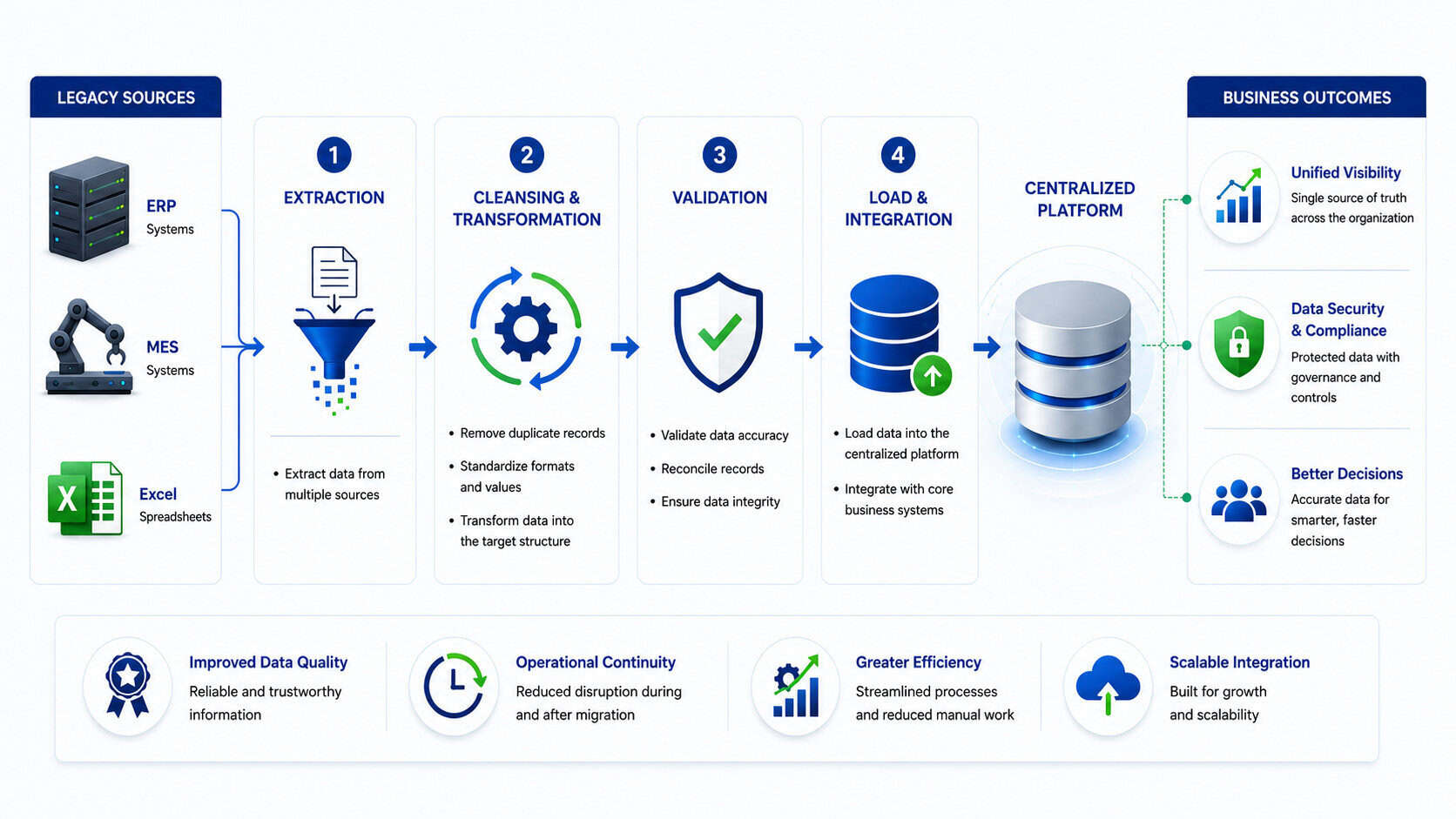
Clean and Standardize Data Before Migration
Migrating poor-quality information creates larger problems later.
Common issues include:
- Redundant information
- Inconsistent naming conventions
- Obsolete information
- Missing fields
Before migration, companies should:
- Clean and consolidate records
- Standardize records
- Validate customer and supplier information
- Improve data quality
Clean information creates a stronger foundation for future operations.
Decide Which Systems Stay and Which Systems Go
Acquisitions frequently create overlapping technologies.
Organizations should evaluate:
- Software capabilities
- Maintenance costs
- Scalability
- Integration requirements
- Long-term business goals
The objective is not to replace everything.
It’s to simplify operations and eliminate unnecessary complexity.
Build a Secure Migration Plan
During M&A, organizations face increased cybersecurity exposure.
That’s why cybersecurity in M&A should be considered from the beginning.
A secure migration plan should include:
- System backups
- User access reviews
- Encryption procedures
- Disaster recovery plans
- Testing environments
Security protects both operations and the value of the acquisition.
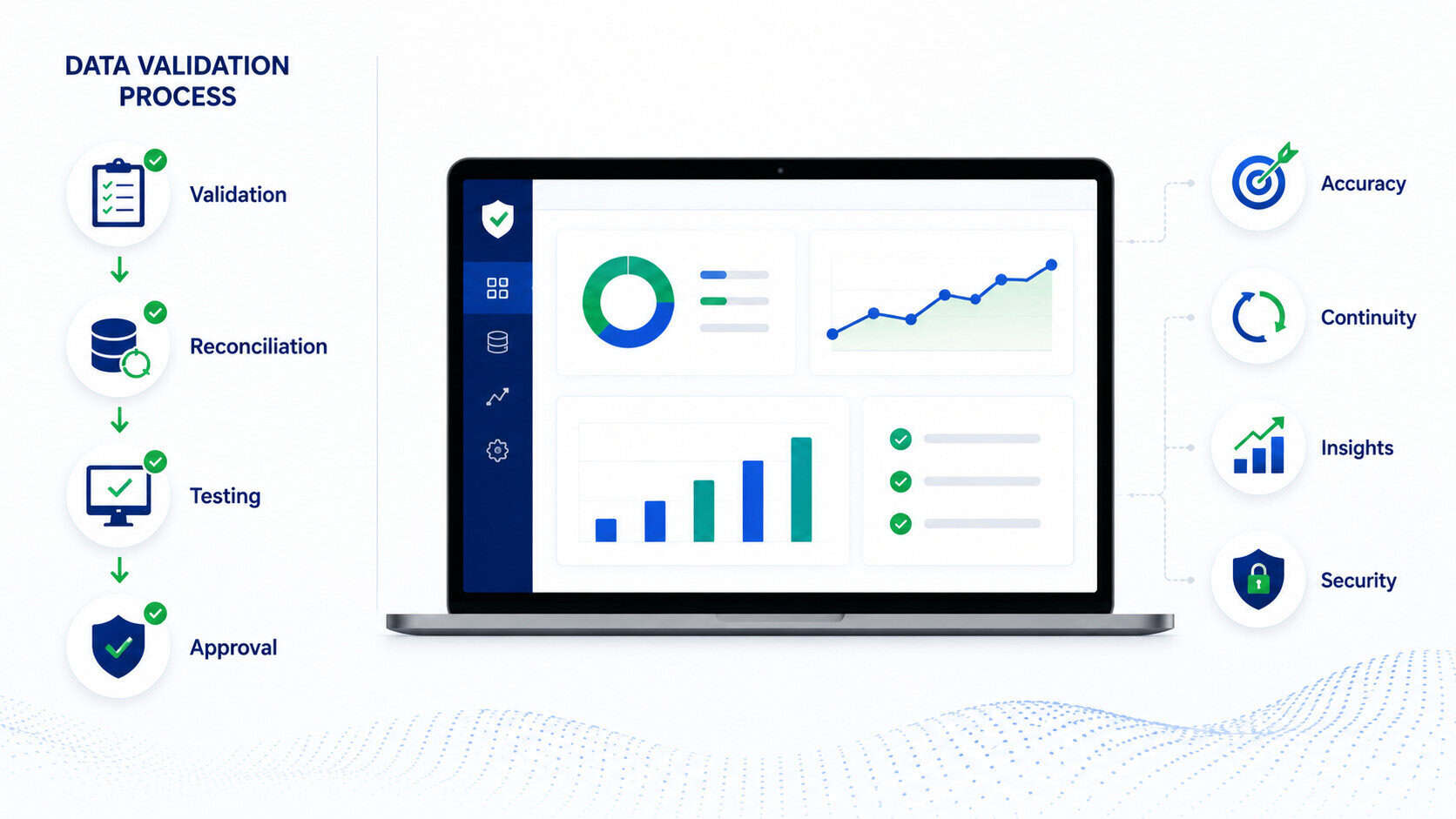
Validate Data Before Going Live
Testing is often overlooked.
Organizations should verify:
- Data accuracy
- Reporting outputs
- Inventory records
- Workflow performance
- System integrations
Validation helps identify problems before they affect operations
Common Data Migration Mistakes During M&A
Even well-planned projects can fail.
Common mistakes include:
- Underestimating complexity
- Migrating unnecessary information
- Failing to clean records
- Relying on manual processes
- Skipping validation
- Lacking ownership
Most problems are preventable with proper planning.
How Data Migration Fits Into IT System Integration
The goal isn’t to replace every system.
It’s to create reliable connections and establish a single source of truth.
A strong migration strategy focuses on:
- Connecting legacy systems
- Improving visibility
- Reducing manual work
- Validating information
- Supporting scalable growth
Good migrations improve operations, not just databases.
Where Unstoppable Fits In
This is where many organizations hit a wall.
They understand the importance of data migration, but they lack the internal resources needed to execute it effectively.
At Unstoppable Software, we focus on solving exactly this.
We build custom solutions that:
• Connect legacy and modern systems
• Unify data across operations
• Support real manufacturing workflows
Helping manufacturers turn data migration into business results.
| FINAL TAKEAWAY |
|---|
M&A success in manufacturing isn’t just financial. It’s operational. And operations run on systems. If you get IT due diligence, IT system integration, and data migration strategy right, you create a foundation for growth. If you don’t, integration becomes the bottleneck. |


