

For years, manufacturers have invested in automation and reporting tools to understand what is happening on the shop floor. Dashboards, alerts, and reports have helped teams react faster than before. But today, manufacturers need foresight, not just hindsight.
Modern manufacturing leaders are moving toward manufacturing AI to anticipate issues, optimize performance, and make decisions before problems impact production. This shift marks the move from reactive reporting to proactive decision making powered by data, analytics, and artificial intelligence.
Manufacturing AI: How Businesses Move From Reactive Reporting to Proactive Decision Making
Manufacturers have traditionally relied on automation systems and reporting tools to monitor operations. These systems helped standardize processes and surface operational metrics after events occurred.
Reactive analytics explains what already happened. Reports show yesterday’s downtime. Dashboards highlight last shift’s scrap rates. While useful, this approach limits how quickly teams can respond to risk.
The shift toward proactive manufacturing focuses on predicting outcomes instead of reviewing past data. With manufacturing AI and industrial AI, organizations can forecast failures, anticipate demand changes, and adjust operations before performance declines. This transition allows data to guide decisions in real time rather than after the fact.
The Limits of Reactive Analytics in Manufacturing
Dashboards and reports are inherently backward looking tools. Even when refreshed frequently, they reflect conditions that have already occurred.
Real time visibility alone is not enough. Knowing that a machine is overheating does not help if the alert arrives too late to prevent downtime. Many manufacturers experience delays because decisions are made after issues escalate.
Reactive workflows often lead to missed opportunities and higher costs. Production bottlenecks persist longer. Quality issues spread before they are identified. Maintenance teams respond after equipment failure instead of preventing it. These challenges highlight the limits of real time manufacturing analytics when they are not paired with predictive intelligence.

What Manufacturing AI Actually Means
- Manufacturing AI is not about replacing people or installing black box systems. At its core, manufacturing AI uses historical and real time data together to identify patterns, forecast outcomes, and recommend actions.
- Unlike basic automation, AI introduces intelligence into decision making. It learns from production history, sensor data, quality records, and operational trends. This capability is closely tied to manufacturing data science, which transforms raw data into predictive insights.
- The difference between automation and intelligence is intent. Automation executes predefined rules. Intelligence adapts based on data and outcomes. Manufacturing AI enables systems to improve decisions over time.
Predictive Analytics as the Foundation of Proactive Operations
Predictive analytics turns data into foresight. Instead of reacting to alarms, teams gain early warnings and actionable recommendations.
Manufacturers use predictive analytics to forecast equipment failures, production delays, demand fluctuations, and quality deviations. These predictions allow leaders to plan maintenance windows, adjust schedules, and optimize throughput.
Two of the fastest paths to value are predictive maintenance and quality assurance. Predictive maintenance identifies failure patterns before breakdowns occur. AI driven quality assurance detects deviations early, reducing scrap and rework. These use cases are often quick wins because they rely on data manufacturers already collect.
This approach supports predictive analytics for business forecasting and planning and strengthens the role of manufacturing data science across operations.
Why Data Readiness Comes Before AI
AI initiatives fail when data is incomplete, disconnected, or inconsistent. Clean, structured, and connected data is essential for accurate predictions.
System integration plays a critical role in predictive accuracy. Production systems, maintenance logs, quality records, and inventory platforms must work together. Without integration, models lack context and insights lose reliability.Manufacturers using real time manufacturing tracking software often struggle when data lives in silos. Rushing into AI without preparing data leads to poor results and lost confidence. Data readiness ensures AI delivers value rather than noise.
How Unstoppable Helps Manufacturers Become Proactive
Unstoppable Software helps manufacturers prepare their data and systems for manufacturing AI without disrupting existing operations. Their approach focuses on enabling progress rather than replacing core systems.
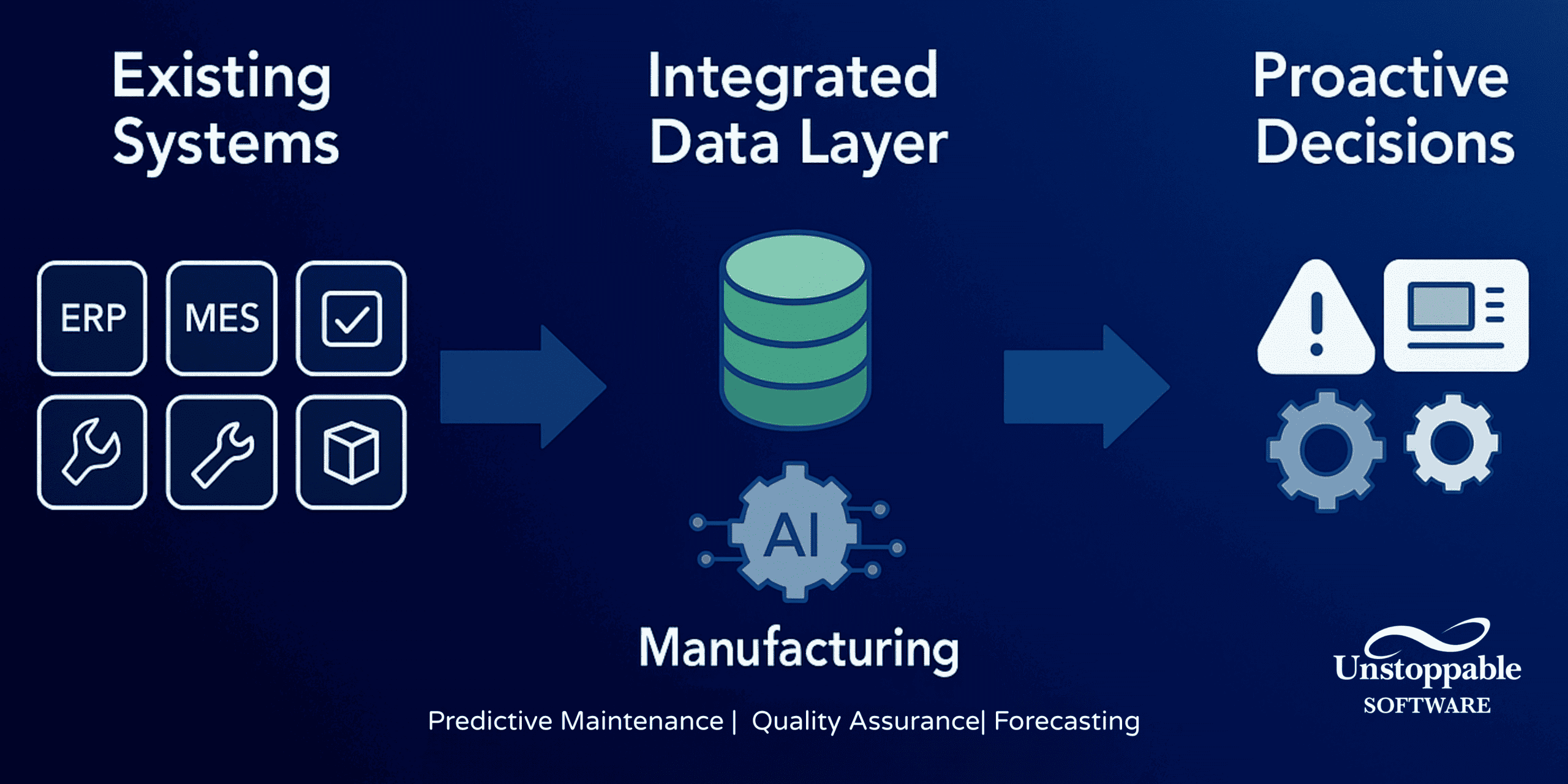
By integrating existing platforms, Unstoppable builds predictive pipelines that support AI driven insights instead of isolated reports. Their custom software solutions connect production data, operational metrics, and historical records into cohesive analytics frameworks.
Unstoppable acts as an enabler, helping teams move from reactive reporting to proactive decision making with industrial AI and scalable analytics.
From Insight to Action
Predictive insights influence daily decision making across operations. Leaders shift from understanding what already happened to anticipating what will happen next.
Manufacturing AI enables faster responses, more confident planning, and measurable competitive advantage. Real world applications move analytics from theory into execution, especially in areas like predictive maintenance and quality assurance.
For teams looking to apply these concepts in practice, the AI in Action eBook provides a grounded guide to using manufacturing AI in real business scenarios. It bridges the gap between data strategy and operational impact, helping leaders turn insights into action using real time manufacturing analytics and predictive systems.
FAQ
What is manufacturing AI and how is it different from automation?
Manufacturing AI uses data driven models to predict outcomes and recommend actions, while automation executes predefined rules without learning or adaptation.
How does predictive analytics support proactive decision making?
Predictive analytics forecasts issues before they occur, allowing teams to plan, prevent downtime, and optimize operations.
Can manufacturing AI work with existing systems?
Yes. Manufacturing AI is most effective when layered onto existing systems through integration rather than full replacement.
How does Unstoppable help companies apply manufacturing AI in practice?
Unstoppable designs custom software, integrates systems, and builds predictive analytics pipelines that support long term AI adoption and operational improvement.


