
MES vs. ERP: What’s the Difference for Modern Manufacturers?
One manufacturer had already invested in a well-known ERP system. The business side was organized: orders were planned, purchasing was under control, and inventory had a system of record. But step onto the production floor and a different reality emerged. Paper labels moved with finished goods, checklists were printed by hand, and operators still relied on spreadsheets and manual updates to keep work moving.
The ERP implementation had succeeded, but the digital process stopped at the factory door. That gap is exactly where a Manufacturing Execution System (MES) changes the story.
ERP helps the business decide what should happen. MES helps the production team make it happen and shows everyone what is happening right now. When the two work together, manufacturers can replace delayed handoffs with a connected flow of decisions, actions, and trustworthy data.
Understanding the Core Difference Between MES and ERP
ERP and MES serve different but complementary layers of manufacturing. ERP plans and coordinates company-wide resources; MES directs, captures, and improves execution on the production floor.
ERP is strongest at business planning and coordination. MES is strongest at real-time production control, visibility, quality, and traceability.
A simple way to think about the difference is:
- ERP helps determine what needs to be produced and what resources are required.
- MES helps manage how that production is actually executed.
The question is rarely ERP or MES. The bigger opportunity is connecting business intent with shop-floor reality.
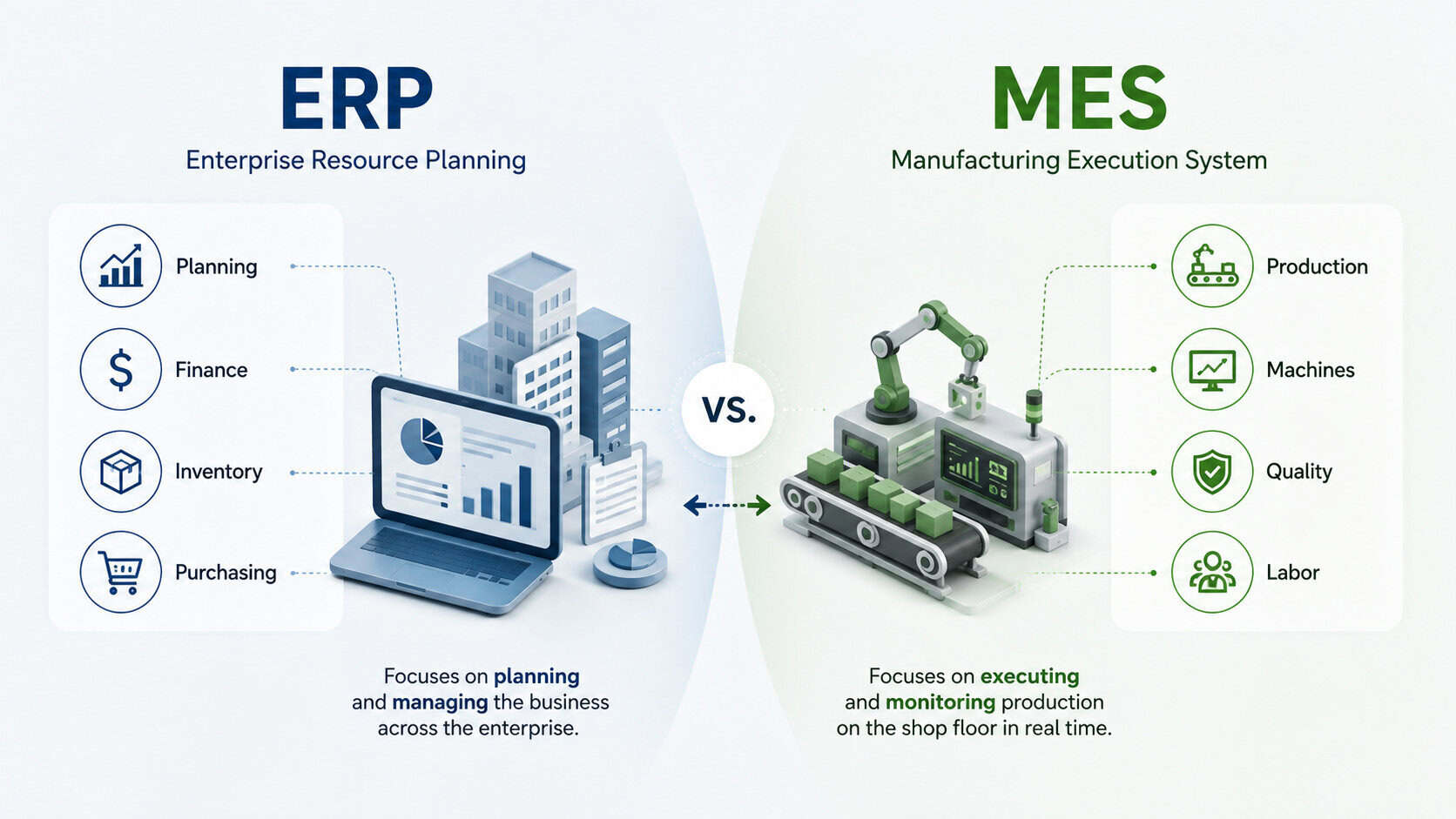
| Visual comparison of ERP and MES, highlighting the different roles each system plays across business planning and manufacturing operations. |
What Does an ERP System Do in Manufacturing?
ERP is the planning backbone of the manufacturing business. It connects finance, purchasing, inventory, sales, suppliers, and production plans so teams can coordinate resources around a shared business picture.
ERP works best for:
- Financials and accounting.
- Purchasing and suppliers.
- Inventory and material planning.
- Sales and customer orders.
- Supply-chain coordination.
- Production planning and schedules.
For example, when a new customer order is received, the ERP can help determine whether the required materials are available, what needs to be purchased, and how the order affects production planning.
ERP can plan the work, but it cannot always reveal whether a batch is falling behind, a material was actually consumed, or a quality check failed five minutes ago. MES closes that execution gap.
What Does an MES Do in Manufacturing?
MES is the operational nervous system of the factory. It guides work, captures production events as they happen, and turns shop-floor activity into usable information.
MES works best for:
- Work-order progress.
- Machine and equipment activity.
- Real-time production data.
- Quality checks and compliance.
- Labor and operator performance.
- Delays and bottlenecks.
For example, once a production order reaches the shop floor, MES can track its progress through each stage, record production results, and alert teams when performance or quality falls outside expected parameters.
That visibility lets teams act before a small deviation becomes missed throughput, wasted material, or a late customer order, and it gives ERP far better data for the next planning cycle.
How ERP and MES Work Together
ERP and MES create the most value when information moves continuously between planning and execution. The office sends clear priorities to the floor; the floor returns detailed production status.
For example, ERP can release a customer order and its material requirements to MES. MES can guide operators through the work, record actual consumption, and immediately return completed quantities and quality results. If a critical ingredient runs low or a process drifts out of tolerance, the right teams can respond before the schedule or the customer absorbs the impact.
This connection helps manufacturers:
- Reduce manual data entry between systems.
- Improve production and inventory accuracy.
- Give business teams better visibility into shop-floor activity.
- Respond faster when production conditions change.
- Make planning decisions using more current operational data.
The goal is not simply to have both systems. It is to make sure ERP and MES exchange the right information at the right time, creating a more connected manufacturing environment.
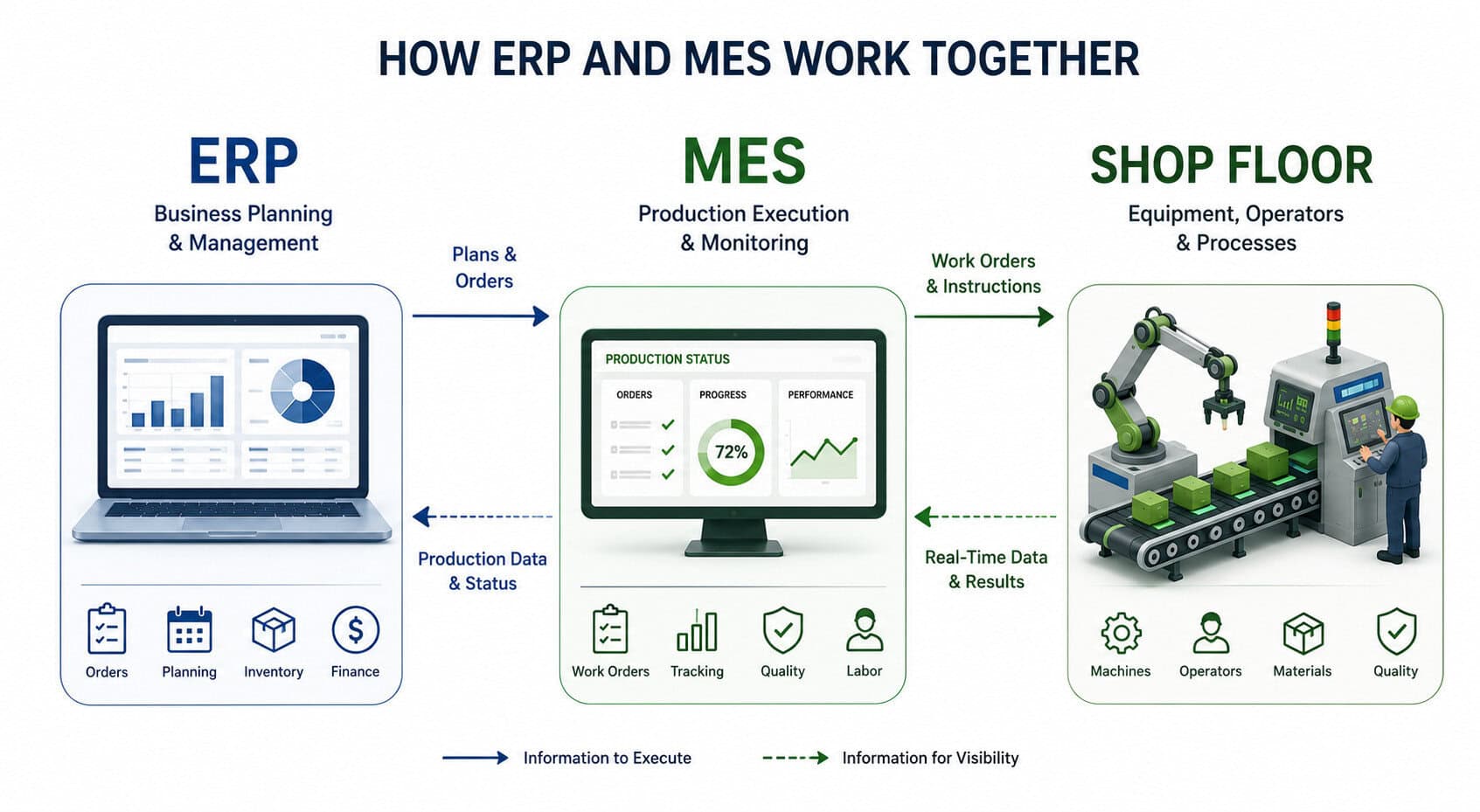
| Diagram showing how ERP, MES, and shop-floor systems exchange planning and production data across a connected manufacturing environment. |
Does Your Manufacturing Business Need ERP, MES, or Both?
Choose based on the operational outcome you need. ERP may solve a planning and coordination problem. MES becomes essential when the business needs tighter control, real-time visibility, and traceability on the shop floor.
ERP may be enough if you primarily need to:
- Manage finances, purchasing, inventory, and orders.
- Improve company-wide planning and reporting.
- Centralize business data across departments.
MES becomes valuable when you need to:
- Monitor production activity in real time.
- Track work orders and production performance.
- Improve quality control and traceability.
- Identify shop-floor issues as they happen.
For manufacturers with complex production environments, ERP and MES often work best together. ERP provides the business-level planning and coordination, while MES provides the detailed production data needed to execute those plans effectively.
For manufacturers with complex production environments, ERP and MES often work best together. ERP provides the business-level planning and coordination, while MES provides the detailed production data needed to execute those plans effectively.
That does not mean every manufacturer needs to implement a large, complex technology stack all at once. The right approach is to identify the specific operational gaps creating delays, manual work, or limited visibility, then connect the systems needed to solve those problems first. Do not add software for its own sake. Build the smallest connected system that removes a real constraint and creates room to grow.
.
Key Considerations Before Integrating ERP and MES
Connecting ERP and MES can improve visibility and coordination, but successful integration requires more than simply linking two systems. Manufacturers need to determine what information should move between them and how that data will support day-to-day operations.
Before integration, manufacturers should consider:
- Data ownership: Define which system is responsible for specific information.
- Integration points: Identify what data needs to move between ERP and MES.
- Data consistency: Standardize product, inventory, order, and production data.
- Existing infrastructure: Consider how legacy systems and equipment will connect.
- Scalability: Make sure the integration can support future production needs.
- Security: Protect data as it moves between business and production environments.
A well-planned integration should simplify operations rather than create another layer of complexity. Starting with clear business and production requirements helps manufacturers build an architecture that can evolve as their technology environment changes.
The Benefits of a Connected ERP and MES Environment
When ERP and MES share accurate information, manufacturers move from reacting to yesterday’s reports to acting on today’s production reality. The payoff is not just cleaner data. It is speed, confidence, and control.
A connected environment unclocks:
- Earlier detection of production issues.
- Stronger quality and traceability.
- Clear production and inventory visibility.
- Faster, more accurate scheduling.
- Faster, data-driven decisions.
- Less duplicate entry and manual reporting.
The larger opportunity is competitive alignment: management can plan with live production intelligence, operations can flex with changing customer demand, and both teams can pursue higher throughput without sacrificing quality.
It also creates the foundation AI needs to be useful. With consistent, contextual production data, manufacturers can apply AI to detect anomalies, anticipate bottlenecks, improve schedules, support operators, and uncover improvement opportunities that disconnected systems keep hidden.
Common Challenges When ERP and MES Aren’t Connected
When ERP and MES operate independently, gaps do emerge between the plan and the production floor. People bridge those gaps manually through duplicate entry, spreadsheets, paper, and delayed updates. This creates friction exactly where speed and accuracy matter most.
The cost of that disconnect shows up as:
- Duplicate data entry across multiple systems.
- Delayed production updates reaching business teams.
- Differences between inventory records and actual material usage.
- Limited visibility into work order progress.
- Manual reporting and spreadsheet-based processes.
- Slower responses to production delays or quality issues.
As production grows more complex, these gaps compound. Connect ERP and MES well, and the same pressure becomes an opportunity: faster throughput, greater flexibility, stronger traceability, and the ability to respond to customer demand before competitors do.
The result is not simply better data. It is a factory that can see, decide, and adapt faster.
Where Unstoppable Fits In
Unstoppable Software helps manufacturers connect ERP, MES, legacy applications, equipment, and other critical systems through custom software development and system integration.
One automotive adhesive manufacturer, for example, replaced a paper-based weighing process with an MES integrated to existing inventory software, PLCs, and real-time sensors. The new system guided and verified operator actions, enabled detailed batch reporting, improved quality, and helped reduce ingredient waste. Read the automotive adhesive manufacturing case study: https://unstoppablesoftware.com/portfolio-posts/unstoppable-software-creates-perfect-recipe-for-automotive-adhesive-manufacturing-process/
| Final Takeaway ERP and MES do different jobs, but their greatest value appears when they operate as one connected system: ERP turns demand into a plan, and MES turns that plan into controlled, visible execution.That connection creates more than efficiency. It gives manufacturers the speed to increase throughput, the flexibility to meet changing customer demands, the insight to protect quality, and the trusted data foundation required to put analytics, automation, and AI to work. The opportunity is not another software implementation. It is a smarter, more responsive manufacturing operation. |