
We’ve worked with manufacturers whose legacy systems have supported production for years, sometimes decades. And in many cases, those systems are still doing exactly what they were built to do.
The problem is everything around them has changed.
New ERP and MES platforms, cloud applications, analytics tools, and security requirements can make older systems increasingly difficult to maintain, integrate, and adapt. But replacing everything at once is rarely the best answer.
In our experience, successful legacy system modernization starts with understanding what still works, where the real limitations are, and what actually needs to change.
This roadmap walks through a practical approach manufacturers can use to modernize aging technology while protecting the processes that keep production running.
Why Do Legacy Systems Become a Problem for Manufacturers?
One thing we’ve learned from working with manufacturers is that legacy systems usually remain in place for a good reason: they support processes the business cannot afford to interrupt.
In fact, this is something we’ve seen repeatedly across manufacturing environments. In our recent look at the analog reality behind digital transformation, manufacturers described operations still relying on manual processes, spreadsheets, and decades-old technology, even while trying to modernize around them.
The issue is not simply that the technology is old. Problems begin when everything around that system continues to evolve while the application itself becomes increasingly difficult to maintain, integrate, or adapt.
Common challenges include:
- Limited integration with newer ERP, MES, cloud, and analytics platforms.
- Dependence on outdated technologies or specialized knowledge.
- Increasing maintenance costs and technical debt.
- Security vulnerabilities and limited vendor support.
- Manual processes needed to move data between disconnected systems.
- Difficulty adapting software to new production or business requirements.
A legacy application becomes a larger business risk when it limits visibility, slows improvements, or makes future technology initiatives harder to implement. That’s why we believe modernization should start by identifying where aging technology is creating the greatest operational constraint, rather than replacing systems simply because of their age.
Step 1: Assess Your Current Legacy Systems
When we look at a legacy environment, the first question isn’t “What should we replace?” It’s “What do we actually have, and what role does each system play?”
Before deciding what to replace or upgrade, manufacturers need to identify which applications are critical to production, how they connect with other systems, and where they are creating operational problems.
The assessment should consider:
- Business criticality: Which systems support essential production or business processes?
- Technical condition: How difficult is the system to maintain, update, or secure?
- Integration limitations: Can it exchange data reliably with newer platforms?
- Operational impact: Are employees relying on manual workarounds or duplicate data entry?
- Future requirements: Can the system support where the business is heading?
This assessment creates a baseline for the modernization roadmap. Instead of treating every legacy application as an equal priority, manufacturers can identify which systems create the most risk or friction and focus modernization efforts where they will have the greatest impact.
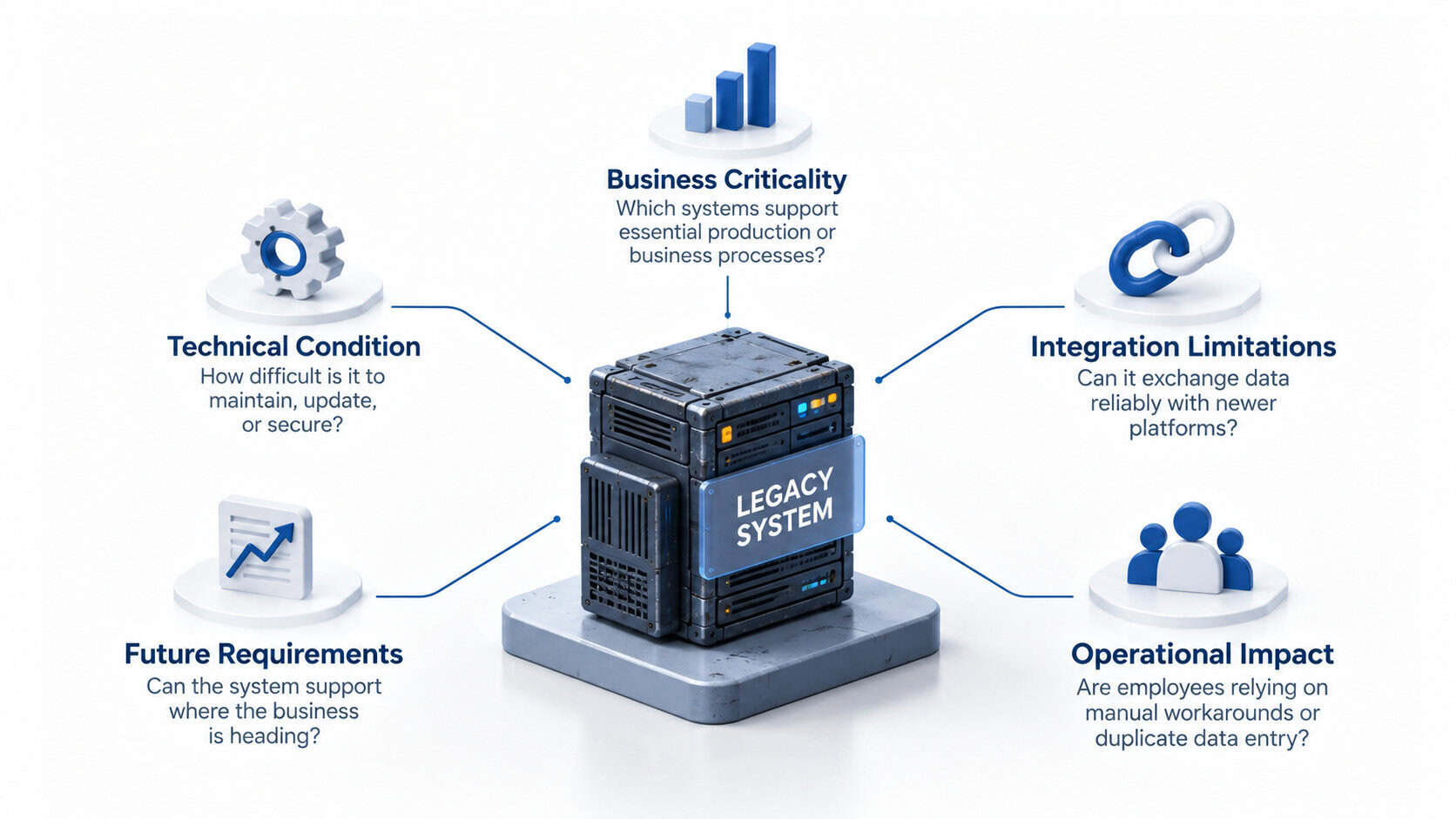
| Assessing legacy systems across business criticality, technical condition, integration limitations, operational impact, and future requirements. |
Step 2: Prioritize What to Modernize First
Once manufacturers understand their existing systems, the next step is deciding where modernization will create the most value. Trying to modernize every legacy application at once can increase cost, complexity, and operational risk.
Instead, manufacturers should prioritize systems based on factors such as:
- Operational risk: Could a system failure disrupt production or other critical processes?
- Business impact: Is the system limiting productivity, visibility, or growth?
- Maintenance burden: Is it becoming expensive or difficult to support?
- Integration needs: Is the system preventing data from moving between newer platforms?
- Modernization value: Would improving the system create measurable operational benefits?
This approach helps manufacturers build a modernization roadmap around business priorities rather than technology age alone. High-risk, high-impact systems can be addressed first, while stable applications that continue to perform effectively may remain in place until modernization provides a clear business benefit.
Step 3: Choose the Right Modernization Approach
This is where modernization gets more nuanced. In our experience, not every legacy system needs the same strategy, and replacing an application entirely is often only one of several options.
Depending on the condition of the application, its business value, and how deeply it is connected to manufacturing operations, the right approach may range from improving the existing system to replacing it entirely.
Common modernization approaches include:
- Rehost: Move an existing application to newer infrastructure with minimal changes.
- Replatform: Upgrade the underlying platform while keeping most of the application intact.
- Refactor: Modify parts of the application to improve performance, scalability, or integration.
- Rebuild: Develop a new solution when the existing architecture can no longer support business requirements.
- Replace: Move to a different software solution when maintaining the legacy system no longer provides enough value.
The right approach should balance technical improvement with cost, operational risk, and business impact. For manufacturers, we’ve found that the strongest modernization strategies are often the ones that improve critical systems without introducing unnecessary disruption to production.
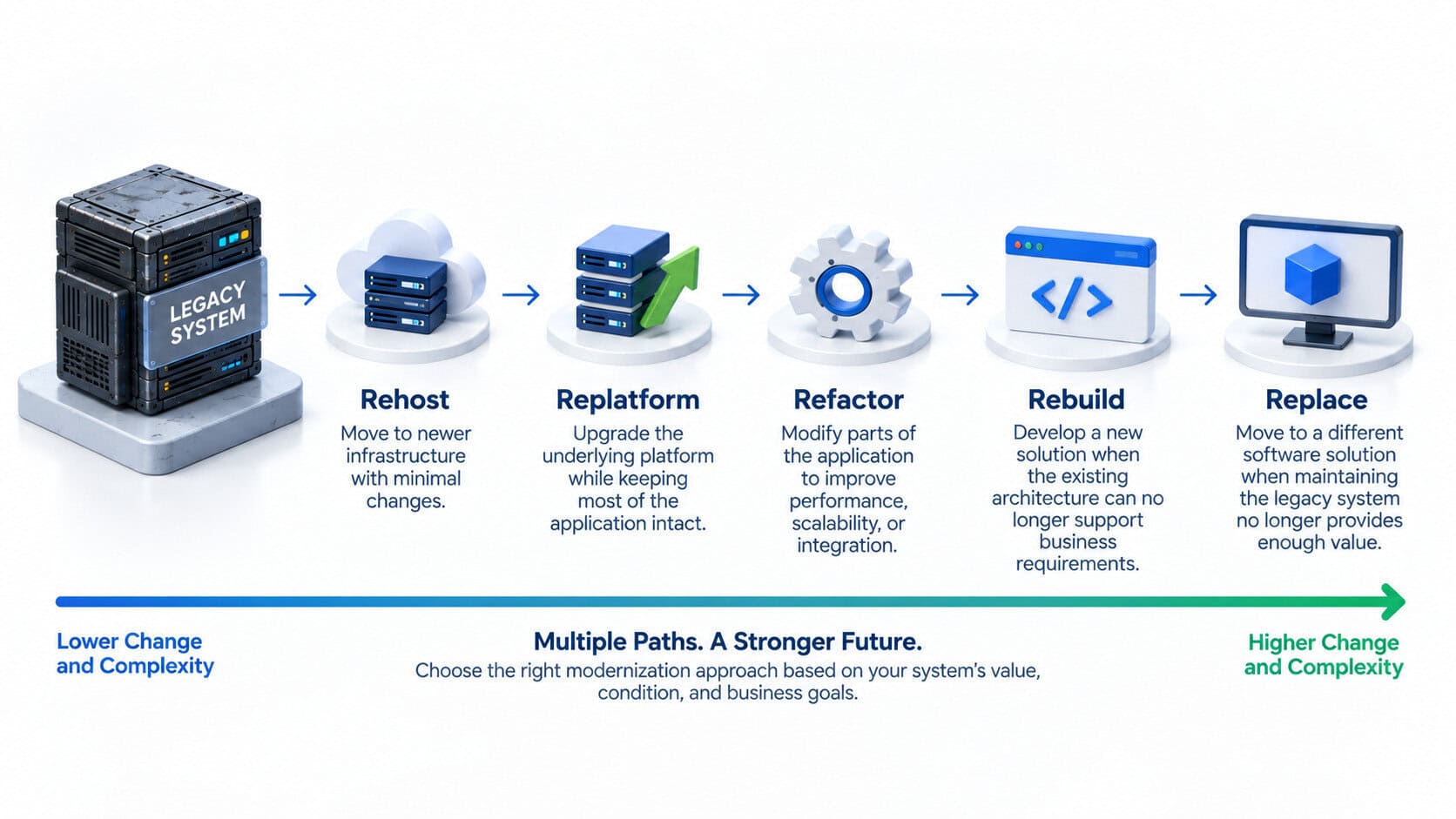
| Common legacy system modernization approaches, from rehosting and replatforming to refactoring, rebuilding, or replacing. |
Step 4: Plan for Integration and Data Migration
We’ve seen modernization projects become much more complicated when data and system dependencies are treated as an afterthought. A legacy application rarely operates in isolation. For manufacturers, it may connect with ERP, MES, production databases, reporting tools, equipment, and other systems that support daily operations.
This is also why we’ve talked before about moving beyond disconnected spreadsheets and building a more reliable manufacturing data foundation. Modernization works best when manufacturers understand not only what needs to change, but how data will continue moving across the broader technology environment.
Before implementation, manufacturers should define:
- Data requirements: Determine what information needs to be migrated, cleaned, archived, or retained.
- System dependencies: Identify applications and processes that rely on the legacy system.
- Integration points: Define how the modernized system will exchange data with existing platforms.
- Testing requirements: Validate data accuracy and system connections before deployment.
- Transition planning: Determine how old and new systems will operate during the migration.
Planning these elements early reduces the risk of broken integrations, missing data, and production disruptions. It also helps ensure the modernized system fits into the broader manufacturing technology environment rather than creating another disconnected application.
Step 5: Modernize in Phases and Test Before Full Deployment
Legacy system modernization does not always need to happen in a single large implementation. For manufacturers, a phased approach can reduce operational risk by allowing teams to validate changes before expanding them across critical processes or facilities.
A phased rollout can include:
- Pilot implementation: Start with a limited process, department, or facility.
- Functional testing: Confirm that the modernized application performs as expected.
- Integration testing: Verify that data moves correctly between connected systems.
- User validation: Involve employees who rely on the system in day-to-day operations.
- Performance monitoring: Track issues, downtime, and system performance during the transition.
- Gradual rollout: Expand deployment after the initial implementation has been validated.
This approach gives manufacturers an opportunity to identify problems before they affect a larger portion of the operation. It also allows teams to adjust the modernization plan based on real-world results rather than committing the entire organization to an untested transition.
Step 6: Measure Results and Continue Improving
For us, modernization is only successful if it creates measurable improvements for the business. Newer technology by itself is not the goal. After deployment, manufacturers should evaluate whether the changes are actually solving the operational and technical problems identified at the beginning of the roadmap.
Useful areas to monitor include:
- System performance: Has reliability, speed, or availability improved?
- Operational efficiency: Have manual processes or workarounds been reduced?
- Integration performance: Is data moving reliably between connected systems?
- Maintenance effort: Has the time or cost required to support the system decreased?
- User experience: Can employees complete critical tasks more efficiently?
- Business impact: Is the modernized system supporting new capabilities or future growth?
We also see modernization as an ongoing process rather than a one-time technology project. The results from one implementation can help manufacturers decide what should be modernized next, while lessons from the rollout can make future modernization efforts more effective.
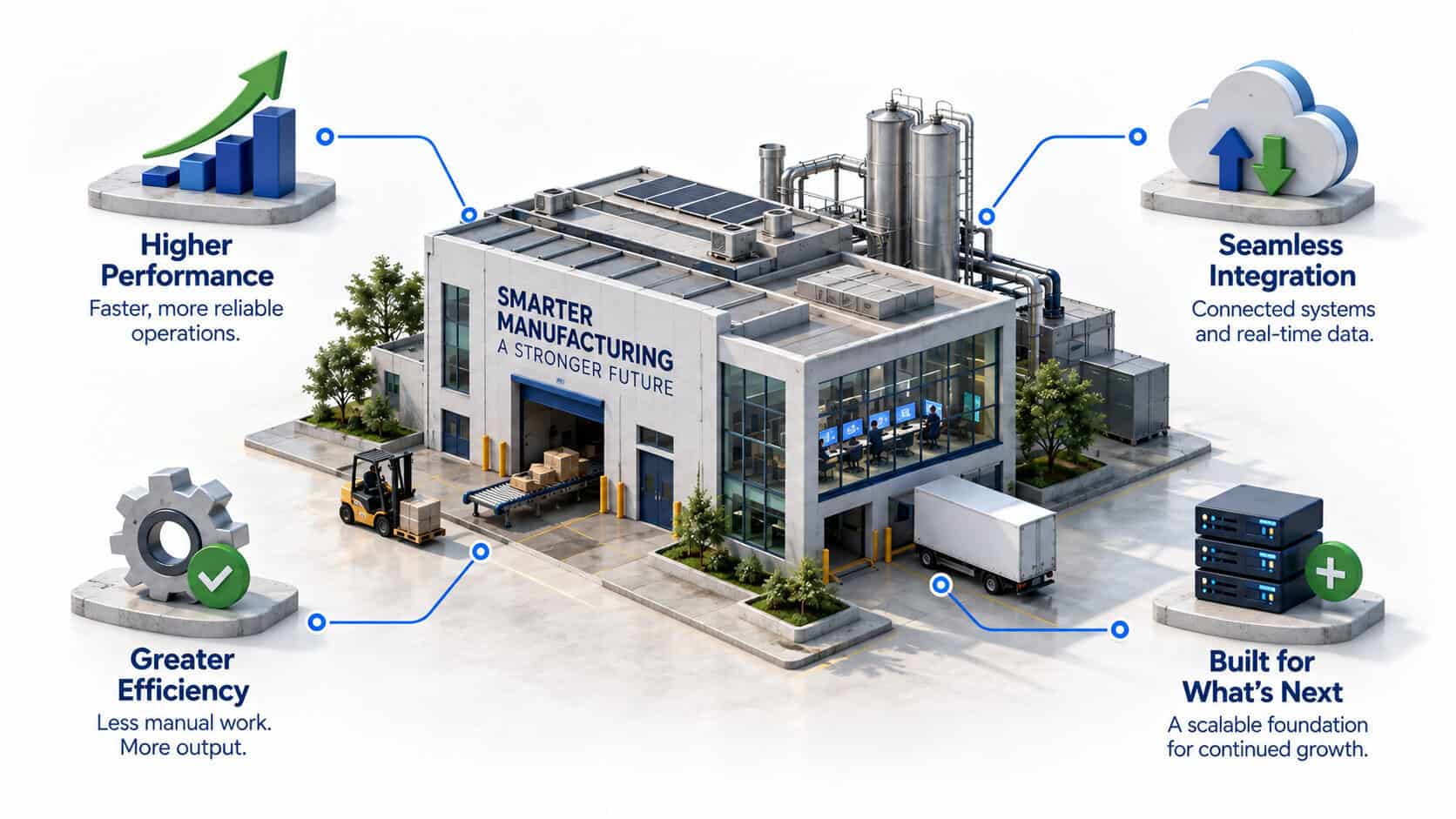
| A modern manufacturing environment focused on higher performance, seamless integration, greater efficiency, and future growth. |
What Does a Successful Modernization Roadmap Look Like?
A successful modernization roadmap does not require manufacturers to replace every legacy system at once. It creates a structured path for improving technology based on business priorities, operational risk, and measurable value.
The strongest roadmaps typically share a few characteristics:
- Business-driven priorities: Modernization decisions are tied to operational needs rather than technology trends.
- Phased execution: Critical systems are improved without introducing unnecessary disruption.
- Connected architecture: Modernized applications can exchange data with ERP, MES, and other essential platforms.
- Measurable outcomes: Improvements in performance, efficiency, maintenance, and integration can be tracked.
- Long-term flexibility: The technology environment can continue evolving as manufacturing requirements change.
For manufacturers, the goal is not simply to eliminate old technology. It is to build a more maintainable and connected environment while protecting the systems and processes the business depends on today.
Where Unstoppable Fits In
At Unstoppable, we work with manufacturers that need to modernize aging applications without losing sight of the systems, integrations, and processes their operations depend on.
Sometimes that means improving an existing application. Other times, it means connecting a legacy system with modern platforms, rebuilding part of the software, or developing a new solution when the existing technology has reached its limits.
Our approach is not about replacing technology simply because it is old. We focus on finding a practical modernization path that addresses real technical and operational limitations while creating a more maintainable, connected, and flexible technology environment for the future.
| Final Takeaway: Legacy system modernization does not have to mean replacing everything at once. In our experience, the strongest modernization efforts start with understanding what is working, identifying what is holding the business back, and making deliberate improvements where they will have the greatest impact. For manufacturers, that means prioritizing the right systems, choosing the right modernization approach, and introducing changes in a way that protects the operations the business depends on today. The goal is not simply newer technology. It is a technology environment that is easier to maintain, better connected, and flexible enough to support what comes next. |
Frequently asked questions
Should manufacturers replace their legacy systems?
Not by default. Legacy systems often still support processes the business cannot afford to interrupt. Modernize where aging technology creates the greatest operational constraint, not because a system is old.
What are the main legacy modernization approaches?
Rehost (move to newer infrastructure), replatform (upgrade the underlying platform), refactor (modify parts of the application), rebuild (develop a new solution) or replace (move to different software).
Which legacy system should we modernize first?
Start with high-risk, high-impact systems: those whose failure could disrupt production, that limit productivity, cost the most to support or block data moving between platforms. Stable applications can stay in place for now.
Why do legacy systems become a problem?
Mostly because everything around them changes: they struggle to integrate with newer ERP, MES and cloud platforms, depend on outdated technology or specialized knowledge, cost more to maintain and may lose vendor support.